|
Cactus Canyon Construction is very interested in being
your adobe building contractor. The first steps toward
this goal have been taken. Currently, we have three
seasons of making bricks with local materials. Each
batch of bricks are better than the previous and we now feel
that we can provide quality wall and old world entry building services.
Adobe projects necessitate planning because the bricks are
formed and cured in the sun. Adobe walls and entries
are not straight concrete walls. They have character
and charm.
If you would like to consider
building an adobe wall or entry to your property, please
call James at 541-647-8195 or send us an email. James
would be glad to discuss your project and develop a free
estimate for you.
We sell adobe bricks for $3.50 each, and entry
and wall projects start at $45 per linear foot
for a three foot high wall (not including footer or roof, if
desired). 12"X16"X4" bricks are semi-stabilized with
portland cement and sealed in place.
Over the past three summers (07, 08 & 09) Cactus Canyon Construction started their
first stabilized adobe brick project. A fully
stabilized brick is water proof. We haven't got there
yet. Below is the north end of an adobe wall. The wall will
be sealed.
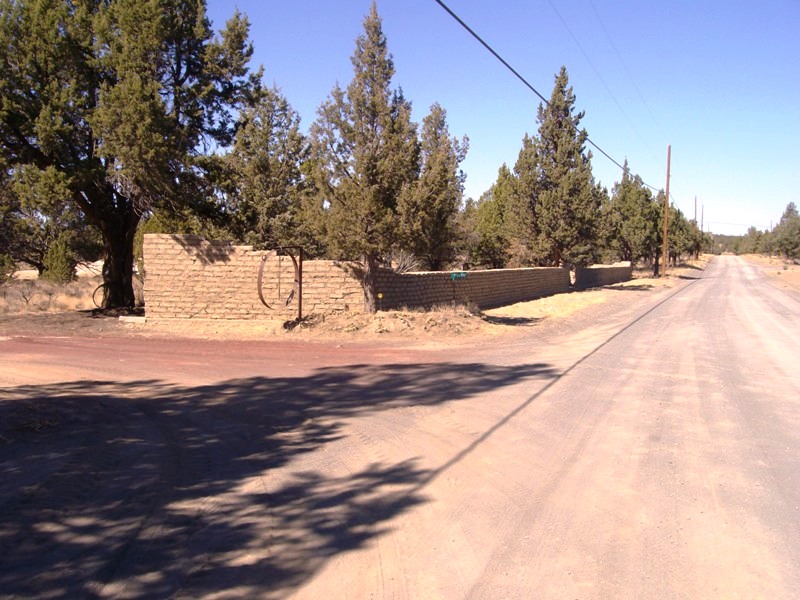
If you would like to see the wall, you can drive by at
15650 SW Dove Road, in the Crooked River Ranch
(west of Terrebonne).
As stated previously, fully stabilized adobe
bricks are water proof. There is hundreds of years of
knowledge related to earth building and adobe. Adobe
structures are beautiful, earth friendly and can help save
on energy costs. The picture below shows both an
adobe wall and also an adobe home with a stucco finish.
The source of the photo is
http://www.nmhomes.com/pics/.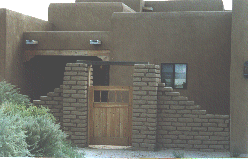
Earth building is one of the oldest methods
in the world and one that can leave the smallest carbon
footprint also.
Did you know that a typical red brick takes
approximately 13,570 BTUs (British Thermal Units) to make
it? A traditional adobe brick 10"X4"X14" requires only 2,500
BTUs, (approximately). Amazing huh! If
we measure an energy quotient, adobe is the best building
block. Check out these further data:
- Paving brick
24,570 BTUs
- Concrete
Masonry Unit (CMU) 8"X8"X16"
29,018 BTUs
- 94lb sack of Portland Cement
381,624 BTUs
- 100lb sack of
hydrated lime
440,619 BTUs
(adapted from The
Earthbuilders’ Encyclopedia” by Joseph M. Tibbet
Follow this
link to see more photos
of adobe building. Thanks for visiting! Give us
a call! We would love to do a project for you!
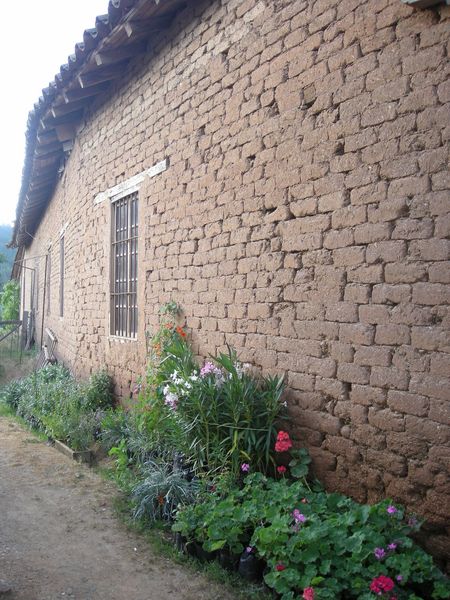
This is a picture
of an adobe wall in Chile. Who knows how many years
old this house is. It is in Vichuquen, and could be
hundreds of years old.
|
Follow this link to view some
adobe houses in Vichuquen, Chile.
Crazy Spaniards built many of these houses in the 16th century
(1500s!). Because of the age of these adobe structures, Vichuquen is a protected pueblo (Zona tipica in 1990).
Sort of like a Chilean National Monument Pueblo.
Cradle to Grave
Analysis
-
What is the source for
the raw material utilized in the building product?
-
Is the raw material
limited or renewable?
-
Does the extraction of
the raw materials cause pollution?
-
How much energy (fuel) is
necessary to transport the raw material to production?
-
Are there hidden costs to
the product manufacturing? i.e. deterioration of water, air
or health of the local population that is not accounted for
by the manufacturer?
-
How much energy (fuel) is
necessary to transport the building products to the
construction site?
-
Do the building products
emit pollution?
-
What is the lifespan of
the product?
-
Once the building reaches
the end of it’s lifecycle, are the materials recyclable?
-
Does the building design
and performance lead to energy conversation?
-
What is the building
materials overall impact on human health?
(adapted from The
Earthbuilders’ Encyclopedia” by Joseph M. Tibbets,
Earthen
construction methods and materials offer real environment
benefits. Adobe materials are mined locally,
manufactured locally, transported locally and will return to the
earth where thence it came.
But the real reason Adobe is special is because
projects and homes built with Adobe are
special!! They are beautiful. Sound does not penetrate adobe walls.
The conductive heat flow of the thermal mass walls mean that
that homes are cool in the summer and warm in the winter.
Adobe is the way to go! To view the advance of an adobe
wall project, click on the projects page in the photo gallery. Give us a call or drop us an email
if you would like to discuss an traditional adobe project.
- Thanks!
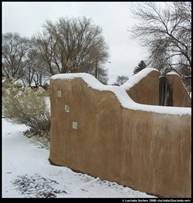
The source for the adobe wall photo is
http://www.lucinda.net/santafe
|